Lease agreement in Cameroon: template, mandatory clauses and registration

Geloka
9 min read
∙August 22, 2026
∙1534 readings
In Cameroon, most tenancies start with a handshake and a handwritten receipt. That works as long as nothing goes wrong. The day the landlord raises the rent without notice, the tenant disappears owing three months, or the deposit never comes back, there is nothing left to show. The lease agreement is the only document that turns a verbal understanding into proof.
Here are the eight clauses your lease must contain, a complete template you can copy as is, the clauses that should make you pause before signing, and the registration procedure almost nobody follows.
A verbal lease is valid, but it proves nothing
Cameroonian law does not require a written document for a residential tenancy. Articles 1713 to 1762 of the Civil Code, which govern leases, recognise verbal and written leases alike. A tenant who has been living somewhere for three years without a single piece of paper does hold a valid lease.
The issue is not validity, it is evidence. In court, the party making a claim must prove it. Without a written record, the rent amount, the move-in date, the number of months of deposit paid and the condition of the property on arrival come down to one person's word against the other's. In that contest, the party holding documents wins, and it is almost never the tenant.
For business premises the logic changes entirely. The OHADA Uniform Act on General Commercial Law governs professional leases in articles 101 to 134, with its own rules on duration, renewal and eviction compensation. If you are renting premises for a business, do not copy a residential template.
The eight clauses your lease must contain
A useful residential lease fits on two pages. Length is not what matters, completeness is. Here is the checklist to run through before signing.
| Clause | What to write | Why it matters |
|---|---|---|
| Identity of the parties | Full names, national ID numbers, addresses and phone numbers of landlord and tenant | Without an ID number you do not know who to pursue if things go wrong |
| Description of the property | City, neighbourhood, precise landmark, type of property, number of rooms, floor, door number | Prevents disputes over what is actually rented, especially the yard, garage or outbuilding |
| Rent and due date | Amount in figures and in words, payment day, payment method | An amount written out in words cannot be altered with a pen after signing |
| Deposit and advance rent | Two separate lines, the amount of each, the number of months each covers | Confusing the two is the single biggest source of dispute when the tenant leaves |
| Term and renewal | Start date, term in months, whether it renews automatically | Determines whether your lease rolls over on its own or simply ends |
| Return of the deposit | Number of days from the exit inspection | With no written deadline, repayment drags on with no simple remedy |
| Charges and repairs | Who pays for water, electricity, routine upkeep and major repairs | Separates routine upkeep, which falls on the tenant, from major repairs, which fall on the landlord |
| Notice period | Number of months for each party and the form the notice must take | Verbal notice can be denied, written notice handed over against signature cannot |
A ninth document sits outside the contract but matters just as much: the entry inspection. Walk through the property with the landlord, note every crack, every leaking tap, every broken switch, take dated photographs, and have both parties sign the sheet. That document, and nothing else, is what stops you paying on the way out for damage you did not cause.
Residential lease template
Copy the structure below and replace the bracketed items. It covers all eight points in the table and takes half an hour to draft.
Heading and parties
RESIDENTIAL LEASE AGREEMENT. Between the undersigned: Mr or Mrs [full name], holder of national identity card number [number] issued on [date], residing at [address], phone [number], hereinafter the landlord, of the first part. And Mr or Mrs [full name], holder of national identity card number [number] issued on [date], residing at [address], phone [number], hereinafter the tenant, of the second part.
Article 1: subject of the lease
The landlord lets to the tenant, who accepts, a [studio, two bedroom apartment, modern room] located in [city], [neighbourhood] area, landmark [precise landmark], door number [number], comprising [list of rooms], together with [yard, garage, outbuilding or none]. The tenant confirms having visited the property and accepts it in the condition recorded in the attached inspection report.
Article 2: term
This lease is granted for a term of [twelve] months from [date], renewable by tacit renewal for the same term, unless either party gives notice in the manner set out in article 8.
Article 3: rent
The monthly rent is set at [amount in figures] CFA francs ([amount in words] CFA francs), payable in advance on the [day] of each month by [cash against receipt, mobile money or bank transfer]. Every payment gives rise to the immediate issue of a dated, numbered receipt signed by the landlord.
Article 4: deposit and advance rent
On signature the tenant pays a security deposit of [amount] CFA francs, equal to [number] months of rent, together with advance rent of [amount] CFA francs covering the months of [month] to [month]. The deposit is not rent and may not be set off against the final months of occupation.
Article 5: return of the deposit
The deposit is returned to the tenant within [thirty] days of the exit inspection and the handover of keys, less any outstanding rent and the cost of tenant repairs recorded jointly, with supporting documents.
Article 6: charges and repairs
Water and electricity bills are payable by the [tenant or landlord]. The tenant bears routine upkeep and tenant repairs. The landlord bears major repairs, in particular the roof, the structure, concealed plumbing and the main electrical installation.
Article 7: tenant obligations
The tenant undertakes to occupy the property peacefully, not to use it for any purpose other than residence, not to carry out structural works without written consent, and not to sublet or assign this lease without the landlord's written authorisation.
Article 8: notice
Either party may terminate the lease by giving [three] months written notice, delivered by hand against signature or by registered letter with acknowledgement of receipt.
Article 9: inspection report
A joint inspection report is drawn up on entry and on exit, signed by both parties. It is attached to this agreement and forms an integral part of it.
Signature
Done at [city], on [date], in [two] original counterparts, each party acknowledging receipt of one. Preceded by the words read and approved, followed by the signature of the landlord and that of the tenant.
Two habits that cost a minute and save months of litigation: have both parties initial every page, not just the last one, and keep your copy somewhere other than the rented property.
Five clauses that should make you pause
Some leases have been passed from hand to hand for twenty years and contain clauses that would not survive a judge. Spotting them before you sign saves you from having to challenge them afterwards.
- The deposit is forfeited to the landlord if the tenant leaves early. A deposit is security against damage or unpaid rent, not an automatic penalty. This clause turns a guarantee into a sanction.
- The landlord may revise the rent at any time. In a fixed term lease the rent is set for the agreed period. A revision clause with no ceiling, no index and no notice leaves you exposed to an increase the month after you move in.
- No inspection report will be drawn up. This is the favourite clause of landlords who intend to keep your deposit. With no written starting point, any damage found on exit will be attributed to you.
- The tenant bears all repairs without exception. That would mean paying for the roof, the load bearing walls and the concealed pipework. Insist on the distinction between routine upkeep and major repairs.
- The tenant waives all remedies. A blanket waiver, drafted in advance and with nothing given in return, carries no serious weight. Its only purpose is to discourage you from making a claim.
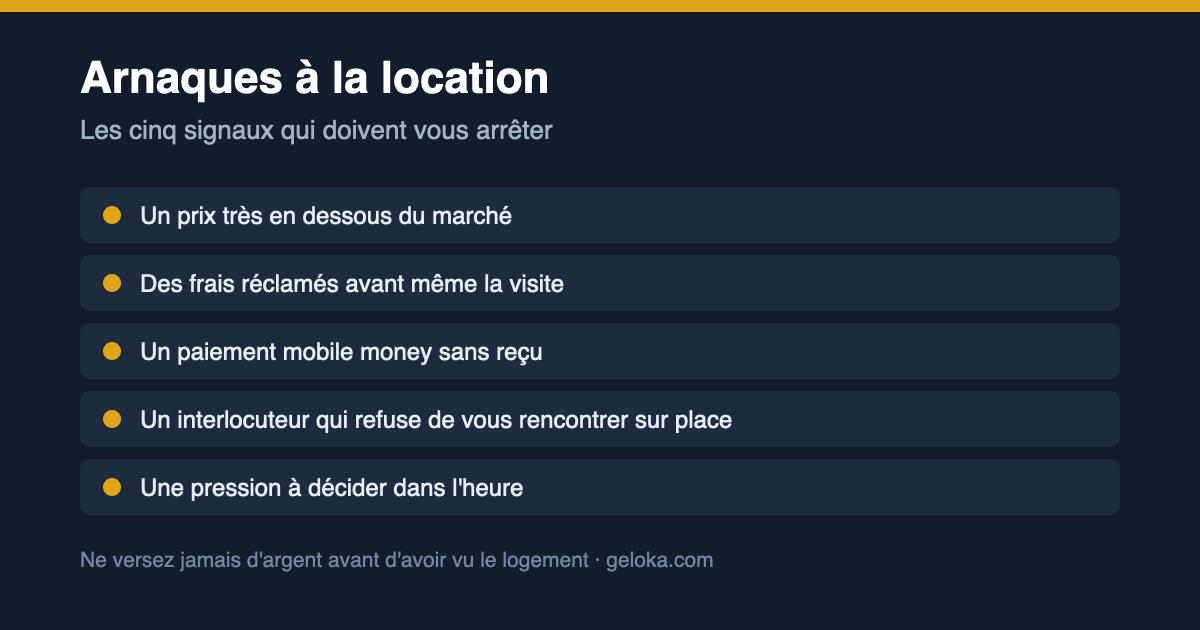
If the landlord refuses to remove any of these, that already tells you something about the relationship ahead. Our articles on the deposit and advance rent and on rental scams set out the other warning signs to know before you hand over a single franc.
Should the lease be registered with the tax office?
Registering a lease with the tax office is a fiscal formality that gives the contract a certain date and makes it enforceable against third parties. In practice very few residential leases are registered in Cameroon, and the absence of registration does not make the contract void between the parties. But a registered lease is far harder to challenge.
The process takes place at the tax centre covering the property. You present the original contract together with three photocopies, with a tax stamp affixed to every page of every copy. The officer records the registration details on the reverse and hands the copies back. Budget for the stamps and the duty calculated on the annual rent, and have the amounts confirmed at the counter, since they change.
Two cases where the formality stops being a luxury: professional or commercial leases, where registration carries weight in your dealings with the administration and your partners, and long leases on a high rent, where the sums involved easily justify a few thousand francs of stamps.
Key takeaways
- A verbal lease is valid but cannot be proved. Writing it down does not create your rights, it makes them defensible.
- Eight clauses are enough: identities, description of the property, rent, deposit and advance kept separate, term, repayment deadline, charges and notice period.
- The entry inspection, signed and photographed, protects your deposit better than any clause in the contract.
- Refuse clauses that remove the inspection, allow free revision of the rent or turn the deposit into a penalty.
- Registration remains optional for residential leases, but it gives the contract a certain date and a strength nothing else replaces.
Before signing, check that the rent being asked matches your neighbourhood. Our article on what a studio costs in Douala and Yaounde gives the observed ranges, and Geloka shows the rent, the neighbourhood and the entry terms directly in each listing, with no middleman.
Join our newsletter
Receive weekly updates about Geloka