Deposit and advance rent in Cameroon: the law and the practice

Geloka
6 min read
∙August 22, 2026
∙1538 readings
Deposit and advance are not the same thing
Confusing the two is the main cause of unpleasant surprises at signing. They are two different sums, with different rules.
| The deposit | The advance | |
|---|---|---|
| What it is for | Securing the landlord against damage and unpaid rent | Paying months of rent upfront |
| Is it returned? | Yes, at the end of the lease if there is no damage | No, it is consumed month by month |
| Usual amount | 1 to 3 months rent | 3 to 12 months rent |
| Capped by law | Yes | No |
The key point: the advance is not money you get back. It covers months during which you will owe no rent, but it leaves your pocket on day one.
What the law says
Cameroonian law caps the deposit at three months rent maximum. Beyond that, the request does not comply.
For a residential lease, the rules of the Civil Code apply, in articles 1713 to 1762. For business premises, it is the OHADA Uniform Act on general commercial law, articles 101 to 134.
The lease must also state within what timeframe the deposit is returned after you leave. Thirty to sixty days is the common benchmark.
What actually happens
On the ground, in Douala as in Yaoundé, the most frequent request on an unfurnished home combines two months deposit and six to twelve months advance. Some landlords go up to fourteen months in total, being twelve months advance plus two months deposit.
This gap between rule and practice comes down to the balance of power: demand for housing far exceeds supply in both major cities, and the landlord sets the terms.
Knowing the deposit is capped will not always win the argument, but it gives you a foothold to negotiate, especially if the landlord wants a stable tenant.
Working out your real move in budget
The advertised rent is only a fraction of what you need to gather. Here is the full calculation on real cases.
| Home | Monthly rent | Deposit and advance | To gather |
|---|---|---|---|
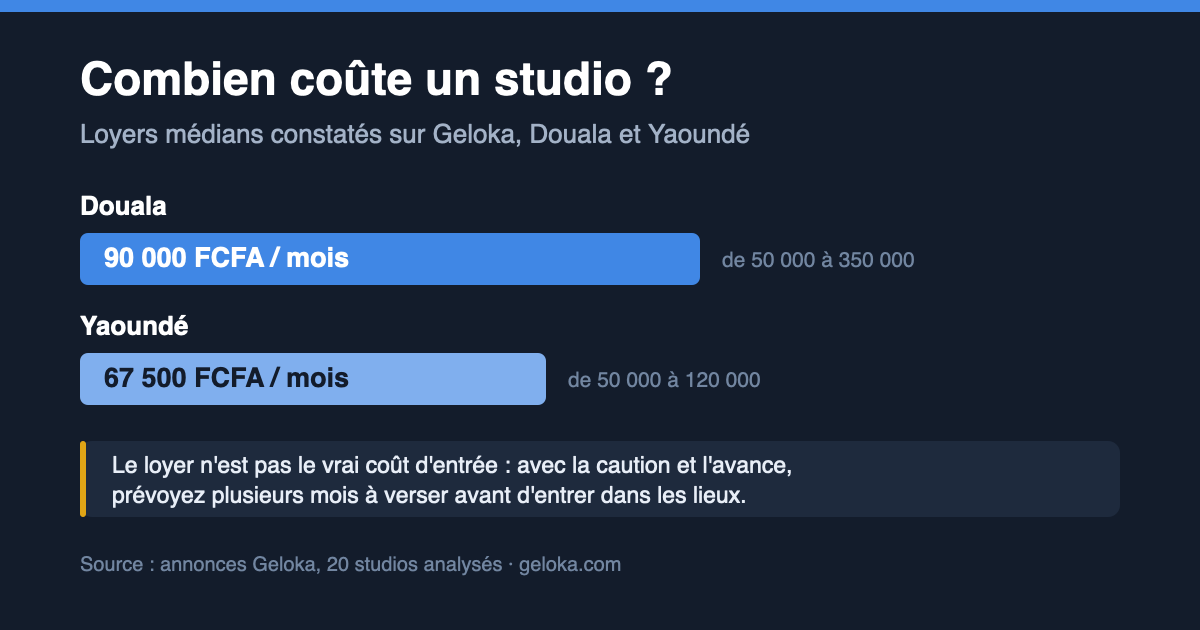
| Studio in Yaoundé | 67,500 FCFA | 2 months + 6 months | 540,000 FCFA |
| Studio in Douala | 90,000 FCFA | 2 months + 6 months | 720,000 FCFA |
| Apartment in Douala | 300,000 FCFA | 2 months + 6 months | 2,400,000 FCFA |
The median rents used here come from our listings, and are detailed in our article on how much a studio costs in Douala and Yaoundé.
A practical rule: multiply the rent by eight to get an order of magnitude for the amount to gather. It is a far more reliable starting point than the rent alone.
Protecting your deposit from day one
Almost every deposit dispute is decided when you move in, not when you leave.
- Do a written inventory check, signed by you and the landlord or their representative, before moving in.
- Photograph everything. Every room, every wall, the bathroom, the sockets, the fittings. Photos must be dated, which a phone does automatically.
- Demand a detailed receipt for the deposit, stating the amount, the date and the words "refundable deposit". A receipt that does not separate deposit from advance will cost you an argument on the day you leave.
- Check that the lease states the return timeframe for the deposit. If it says nothing, ask to add it before signing.
- Keep every proof of payment. A cash payment without a receipt is money you will not be able to claim.
Getting your deposit back
Give notice of your departure within the period set in the contract. Ask for a joint exit inventory, carried out with both parties present, and compare it with the entry one.
If the landlord withholds all or part of the deposit, ask for a written breakdown of the deductions. Normal wear and tear over time cannot be charged to you: it is distinct from damage.
If matters stall, a written formal notice is the first formal step. The next remedy lies with the competent court, on the basis of the Civil Code provisions applicable to leases. That is where the entry inventory and the receipts make all the difference.
What to negotiate
Most tenants try to negotiate the rent. That is often the hardest point to move, because it sets the reference for future tenancies.
Negotiate the number of months of advance instead. A landlord will often prefer cutting the advance from nine to six months rather than lowering the rent by 10%. You can also offer to pay the advance in two instalments, or commit to a longer term in exchange for a reduced advance.
Dealing directly with the landlord, without an intermediary, also removes fees that often amount to one month of rent.
Frequently asked questions
How many months deposit can a landlord ask for in Cameroon?
The law caps the deposit at three months rent maximum. In practice a two month request is the most common, on top of an advance that is not capped.
What is the difference between the deposit and the advance?
The deposit is a guarantee returned at the end of the lease if there is no damage. The advance is months of rent paid upfront: it is not returned, but it covers a period during which you owe nothing.
Within what timeframe must the deposit be returned?
The lease must state it. Thirty to sixty days after moving out is the usual benchmark.
Can the landlord refuse to return the deposit?
They may only withhold the cost of real, justified damage, distinct from normal wear and tear, and must give you a written breakdown. A signed and photographed entry inventory is your best protection.
What if the landlord asks for twelve months advance?
Unlike the deposit, the advance is not capped by law. You can negotiate its length, offer to pay in instalments, or look at another property. It is the item landlords concede most readily.
Key takeaway
The law caps the deposit at three months, but the advance escapes that limit, and it is the advance that weighs most. Reckon on roughly eight times the rent to estimate your move in budget.
Protect your deposit on the day you move in, not the day you leave: signed inventory, dated photos, a receipt bearing the words refundable deposit. This guide is general information, and a legal professional remains the right contact for a specific situation.
Join our newsletter
Receive weekly updates about Geloka