Land sale certificate in Cameroon: what it is really worth

Geloka
5 min read
∙August 22, 2026
∙1534 readings
What a land sale certificate actually is
In Cameroon, the sale certificate is the document a buyer and a seller sign between themselves when land changes hands. It is often handwritten, signed in front of witnesses, sometimes legalised at the town hall or the police station. Thousands of plots change owner this way every year in Douala, Yaoundé and the surrounding areas.
Legally, it is a private agreement. It proves that an agreement existed between two people and that money was paid. That is already useful, but it goes no further.
Does this document make you the owner?
No, and this is what most buyers discover too late.
Cameroonian law requires a notarial deed for property transactions between private individuals. The notary drafts the deed, registers it with the tax authorities, then forwards the file to the land registry services. Only the land title, issued at the end of that procedure, establishes ownership against everyone.
In other words, a sale certificate signed in the neighbourhood or even at the police station gives you proof of payment, not a right of ownership. In a dispute, if the seller resells the same plot to someone who does obtain the land title, your certificate will carry little weight.
That does not make it worthless. A good faith buyer can use it to demand that the sale be carried out if the seller backs out. But it is a starting point, never an end point.
What must appear on the document
An incomplete sale certificate is almost impossible to defend. Check that yours contains:
- full identity of both parties: names, parentage, date and place of birth, identity card number, address, marital status and nationality
- precise description of the plot: locality, neighbourhood, exact area in square metres, boundaries and immediate neighbours
- the land title reference, or the reference of the original document if one exists
- the agreed price, written in figures and in words
- payment terms and acknowledgement of any sums already paid
- date and place of signature
- signatures of both parties and of at least two witnesses
Marital status is not a detail. If the seller is married under a community property regime, selling joint property without the spouse's consent can be challenged years later.
Documents to demand from the seller before signing
| Document | Why it matters |
|---|---|
| Original land title | The only proof of ownership that holds against third parties. Ask to see the original, not a photocopy. |
| Seller's identity document | The name must match exactly the one on the title. |
| Survey plan approved by the cadastre | It sets the real boundaries and prevents boundary disputes. |
| Land tax receipt | Proves the tax obligations on the plot are up to date. |
| Spouse's consent | Required if the seller is married under a community property regime. |
| Certificate of no dispute | Confirms no proceedings are pending on the plot. |
If the seller refuses to produce the original land title, or keeps finding reasons to postpone the visit to the notary, treat it as a serious warning sign.
From sale certificate to land title
The sale certificate is only one step. Here is the full path:
- Prior check at the land registry that the title exists and is in the seller's name.
- Signature of the sale certificate or preliminary agreement, with a deposit.
- Visit to the notary, who draws up the formal deed of sale.
- Registration of the deed with the tax authorities and payment of duties.
- Filing at the land registry: stamped application, cadastre approved plan, notarial deed and copy of the original land title.
- Issue of the new land title in your name, or of the subdivision if you are buying only part of the plot.
Costs include the notary's fees, registration duties, tax stamps and survey fees. Ask the notary for a written estimate before committing.
The mistakes that cost the most
Paying in full before the notary stage. Pay a deposit, keep the balance for the signature of the notarial deed.
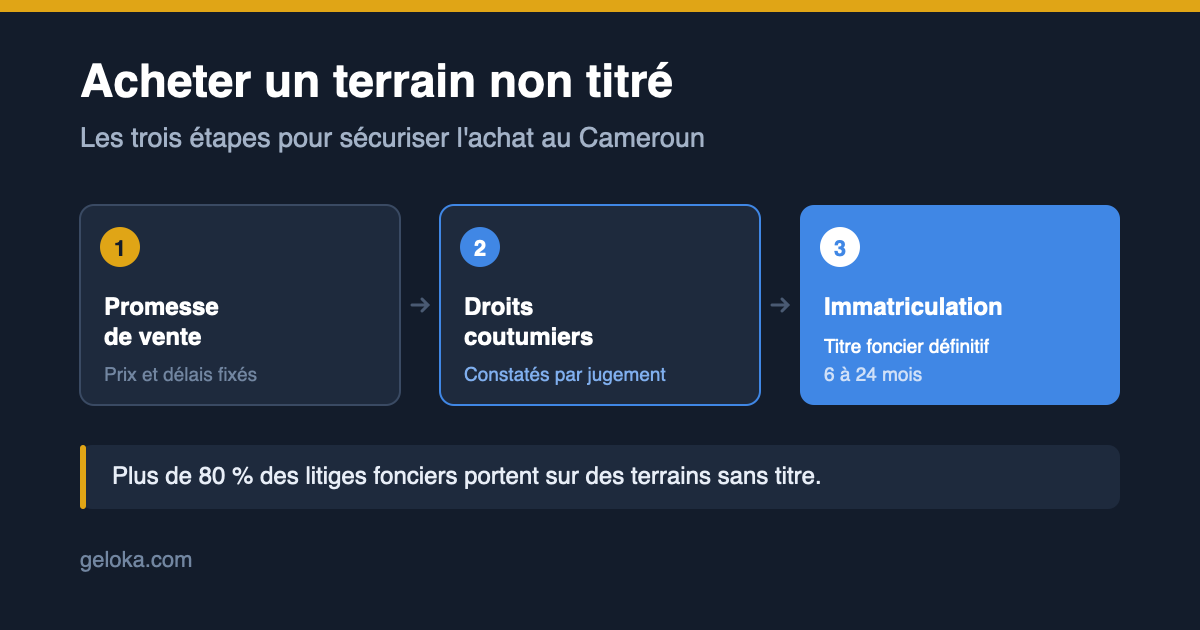
Buying untitled land expecting to regularise later. The registration procedure is long, expensive, and its outcome is never guaranteed.
Accepting a photocopy of the land title. Forgeries exist. A direct check at the land registry costs little and prevents most bad surprises.
Skipping the boundary survey. Many disputes are not about ownership but about the exact limits of the plot.
Dealing with an intermediary without written authority. Insist on meeting the owner named on the title.
Frequently asked questions
Is a certificate signed at the police station worth more?
Legalising signatures confirms that the parties did sign before an authority. It strengthens the evidence, but it does not turn a private agreement into a title of ownership.
Can you buy land without a land title?
It is common, but risky. You are then buying occupation, not ownership. If you choose that route, do it knowingly and budget for the cost and duration of registration.
How long does it take to obtain the land title?
Timeframes vary widely depending on the region, how complete the file is and the type of land. The departmental land service covering the plot is best placed to advise you.
What if the seller refuses to go to the notary?
That is a major warning sign. Going through a notary is a legal requirement, not a negotiable formality. A seller who resists usually has something to hide about the origin of the property.
Key takeaway
The sale certificate is a useful document, but it does not make you the owner. It protects you during negotiation, not against a resale. Real security comes only from the notarial deed and the registration of the land title in your name.
This guide is general information. Every land situation is specific, and consulting a notary or a lawyer before any commitment remains essential.
Join our newsletter
Receive weekly updates about Geloka