Buying untitled land in Cameroon: risks and procedure

Geloka
5 min read
∙August 22, 2026
∙1538 readings
What untitled land actually is
Untitled land is a plot that has never been registered in the land register. Nobody owns it in the legal sense of the word. What exists are occupation rights recognised by custom, passed down through generations, often with no written document at all.
In Cameroon these plots make up most of the land available on the outskirts of Douala, Yaoundé and in rural areas. They are cheaper, sometimes two to three times cheaper than an equivalent titled plot, and that is exactly what attracts buyers.
One figure to keep in mind: over 80% of land disputes in Cameroon involve plots without a title. The discount is not a gift, it is the price of the risk.
What you are really buying
When you buy untitled land, you are not buying ownership. You are buying occupation, that is the position of someone who uses the plot and whom the local community recognises as legitimate.
This distinction is not theoretical. Until registration is obtained, you cannot mortgage the land with a bank, you cannot resell it with a solid guarantee, and your position remains open to challenge by anyone claiming earlier customary rights.
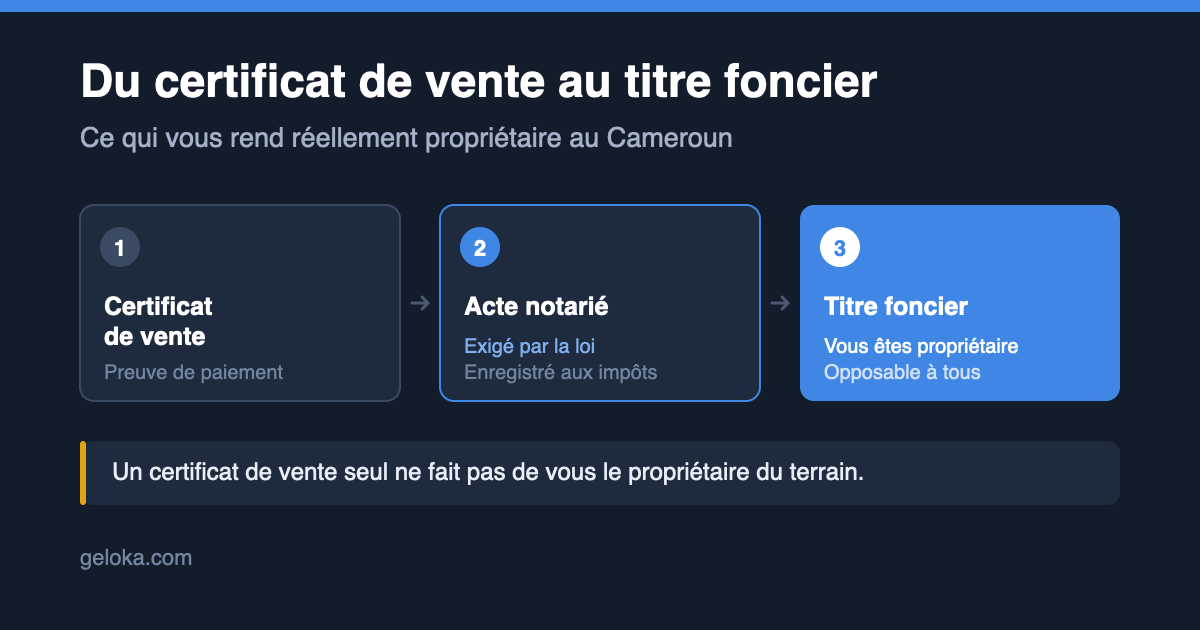
The same reasoning applies as for the sale certificate: a document signed between private parties proves a transaction, it does not establish ownership.
The three steps to secure the purchase
Buying untitled land is not a mistake in itself. It is an operation that requires going through a full procedure, not stopping once the price is paid.
- The preliminary agreement. It commits the seller to transfer the plot on the agreed terms, price and deadlines included. It protects you while you carry out your checks.
- Establishing customary rights. Court proceedings confirm that the occupation is real and peaceful. You generally need to show continuous occupation for more than five years and produce an administrative certificate. If the judge recognises those rights, a judgment records them.
- Registration. With that judgment, you file the case with the land registrar to obtain the final land title. Expect roughly six to twenty four months of processing.
Many buyers stop after the first step, assume they are owners, and discover the problem ten years later when reselling or passing the property on.
The customary rights waiver certificate
This is the central document in this kind of transaction. Through it, the holder of the customary rights acknowledges transferring them to you.
One piece of advice prevents most disputes: insist that two of the seller's children attend and sign as witnesses. Customary rights pass down through family lines, and challenges almost always come from heirs, sometimes years after the sale, claiming the parent had no authority to sell family property alone.
Also have the transfer witnessed by the traditional chief of the village or neighbourhood, and keep the administrative certificate issued by the local authority.
The documents to gather
| Document | What it establishes |
|---|---|
| Customary rights waiver certificate | The transfer of rights by their holder, with witnesses. |
| Administrative certificate | Recognition of the occupation by the local authority. |
| Traditional chief's attestation | Customary validation of the transfer. |
| Survey plan | The exact boundaries of the plot, before any dispute arises. |
| Court judgment | Judicial recognition of the customary rights. |
| Identity documents of the parties | Who the seller is and whether they can transfer. |
When you should walk away
The seller cannot prove at least five years of occupation. Without it, establishing customary rights has little chance of succeeding.
Several people claim the plot. Family land whose heirs disagree is an almost certain source of litigation.
The land sits in classified national domain, a flood zone, a road easement or a reserve. Some plots can never be registered, whatever the amount invested.
The seller refuses the court procedure. If they want to be paid and disappear, it is because they know their rights would not survive scrutiny.
The price is abnormally low. In this market, an excessive discount almost always signals a problem known to the seller and unknown to the buyer.
Frequently asked questions
Can you obtain a land title on untitled land?
Yes, that is the very purpose of the registration procedure. It requires having customary rights established in court, then filing with the land registrar. Processing generally takes six to twenty four months.
How long must land be occupied to claim customary rights?
Occupation must be peaceful and continuous, and more than five years is generally required. It is for the seller to provide that proof, not for you to assume it.
Is the customary rights waiver certificate enough?
No. It records a transfer of occupation rights, it does not create ownership. Only registration leading to the land title makes you the owner.
What happens if the seller's heirs challenge the sale?
That is the most common dispute. Having two of the seller's children sign as witnesses greatly reduces the risk, as does witnessing before the traditional chief.
Can you build on untitled land?
In practice, many people do. But without a title you are building on property you do not legally own, and you will not obtain bank financing secured on the land.
Key takeaway
Untitled land is cheaper because it is less secure. The price gap matches the cost and the risk of regularisation, which you will pay later, in money and in time.
If you go ahead, go all the way to registration, and budget the procedural costs from the start. This guide is general information: every land situation is specific, and support from a notary or a lawyer before any payment remains essential.
Join our newsletter
Receive weekly updates about Geloka